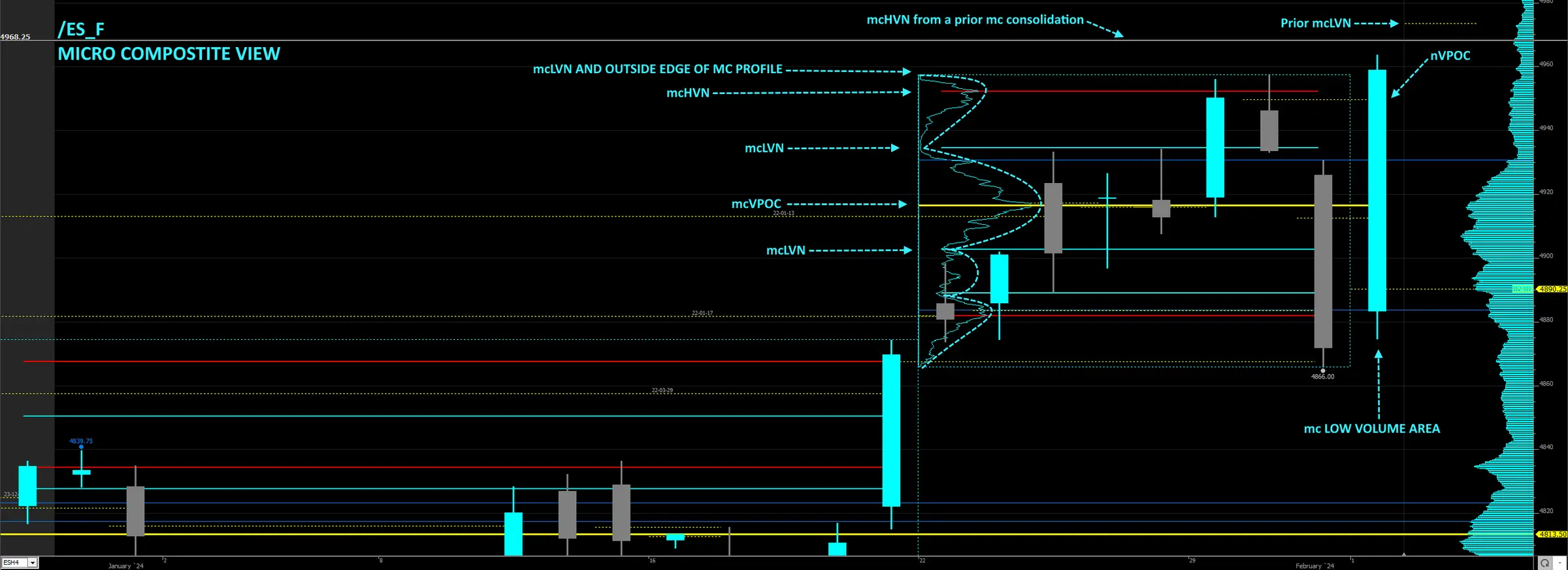
Context keeps the trader aligned with the auction. Before choosing a direction or deploying a setup, we first determine what the market is doing, which references are material, and how we will respond if the initial scenario fails.
Balance, imbalance, and price discovery require different expectations—and different behavior.
We often discuss a hierarchy of inputs for good reason: it keeps us grounded in the trading systems we have developed and vetted. With endless software, indicators, and analytical tools available, it is easy to become myopic and board a runaway train of complexity.
Simplicity is stressed because complexity obscures. Many tools are generic, time-specific, or fractal-specific. Context supersedes them because context describes the auction process itself.
At a practical level, the market can be balanced, imbalanced, or engaged in some form of price discovery. Each condition contains nuance, but we can begin by organizing the auction into two broad states: balanced and trending.
Balanced Context
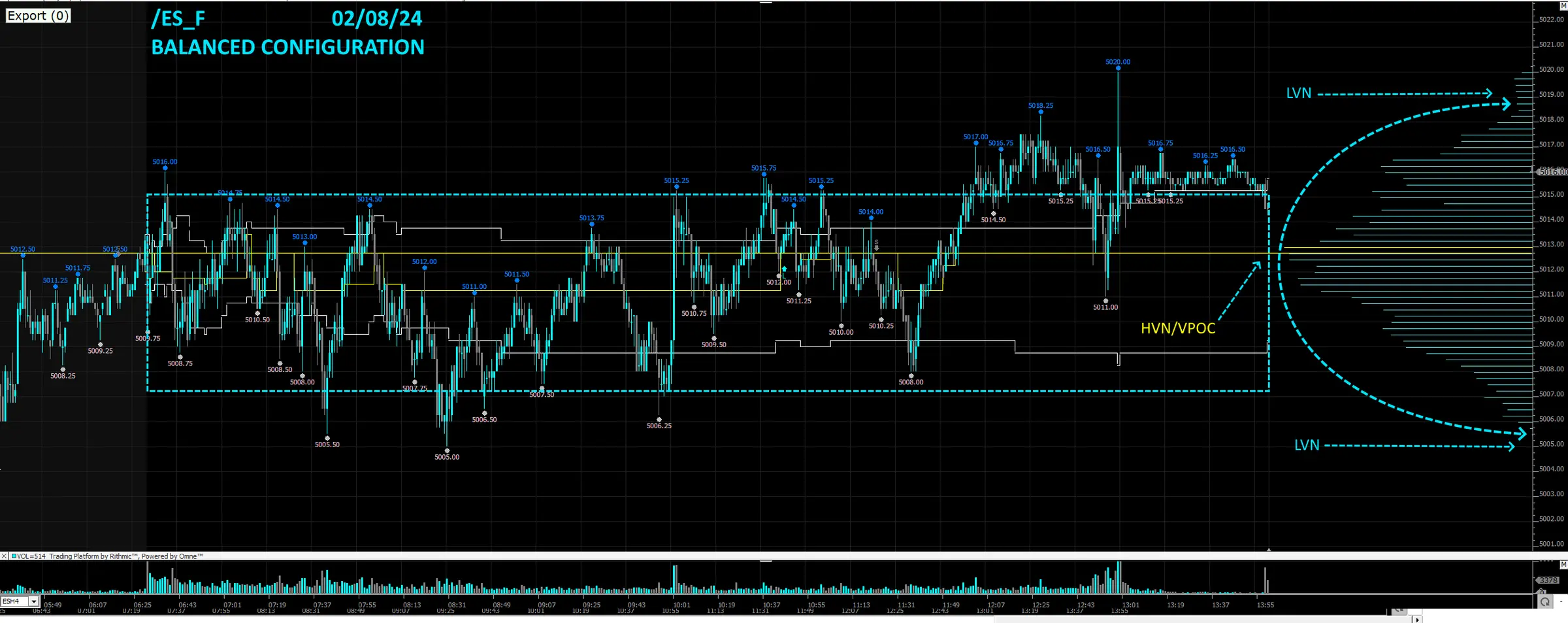
A truly balanced market often produces a smooth, bell-shaped volume profile. Price rotates between the outside edges and repeatedly returns toward the Volume Point of Control (VPOC)—the price at which the greatest volume has traded and the auction has expressed the most acceptance.
This is mean reversion. The auction checks lower-volume edges, discovers whether price is accepted or rejected, and often returns toward fair value.
The same behavior appears across fractals. As day traders, we may focus on the developing regular trading hours (RTH) session, but higher-time-frame context must remain visible.
A balanced RTH auction repeatedly checks low-volume edges and rotates toward the VPOC.
This session provides a textbook balanced configuration. The auction tests the outside edges—low-volume nodes (LVNs)—and repeatedly returns toward the center, where the greatest amount of volume has traded.
Range extensions can still occur inside a balanced day. A push beyond the recent boundary may look like the beginning of a breakout, yet still function as nothing more than another price check. The observable truth remains: until the auction demonstrates sustained acceptance elsewhere, the context is balance.
Trade Balance Until It Is Not
Traders naturally want to anticipate every move. A range extension, stop run, or sudden burst of activity can tempt us to declare, “This is the breakout.” The reality is that we do not know. The next outcome remains random.
If the plan calls for qualified outside-in trades during balance, we continue to take them while the context remains intact. A stopped trade does not automatically mean the context has changed. It may be an invitation to pause, narrate, and determine whether the auction is transitioning—or merely completing another check before mean reversion.
Not every event is actionable. Sometimes the best response is to take our hand off the mouse and let the participants reveal more information.
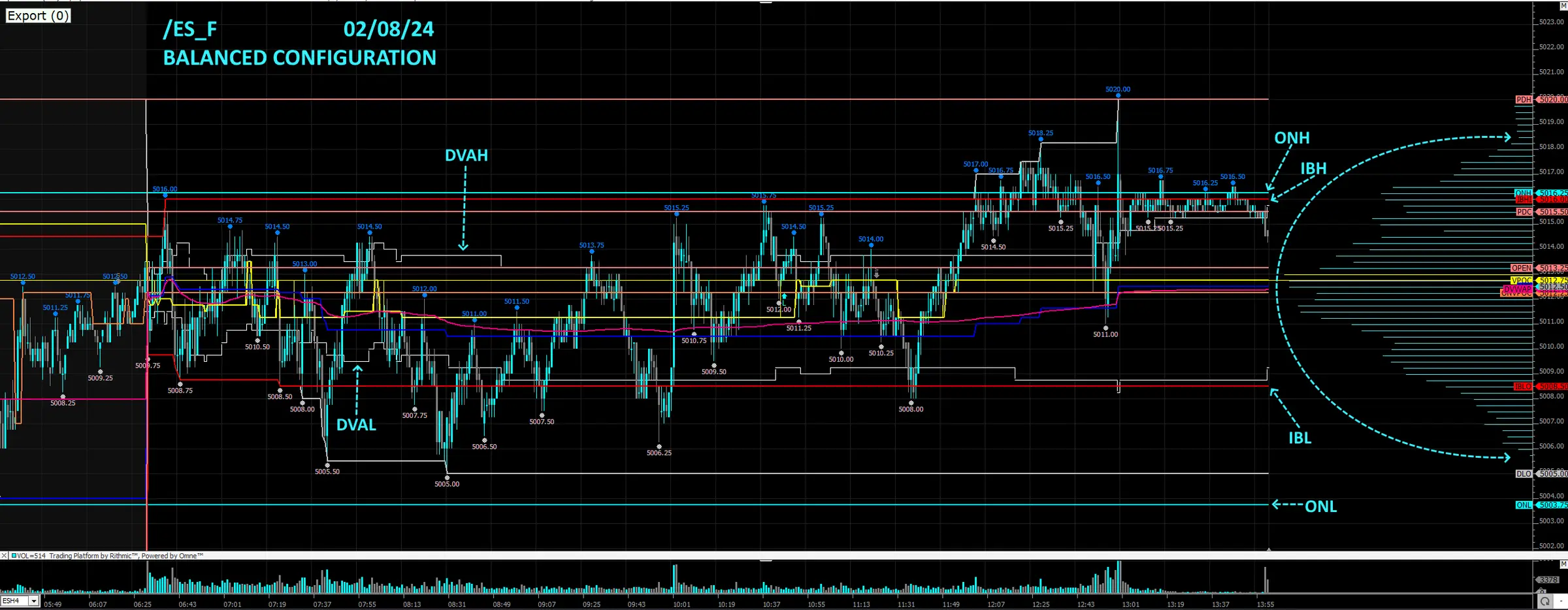
The same balanced auction with overnight and session references restored.
Adding session references reveals Overnight High (ONH) and Overnight Low (ONL) just outside the developing balance. These may become high-statistical targets, but their proximity does not justify entering from the wrong side of the distribution.
Our DNA wants to get short near the southern edge because ONL is close, or long near the northern edge because ONH is close. But balance is traded from the outside in. Risk is first mitigated through the expected rotation; only remaining contracts should pursue references outside the distribution.
Trade the balanced configuration until it is not.
Trending Context
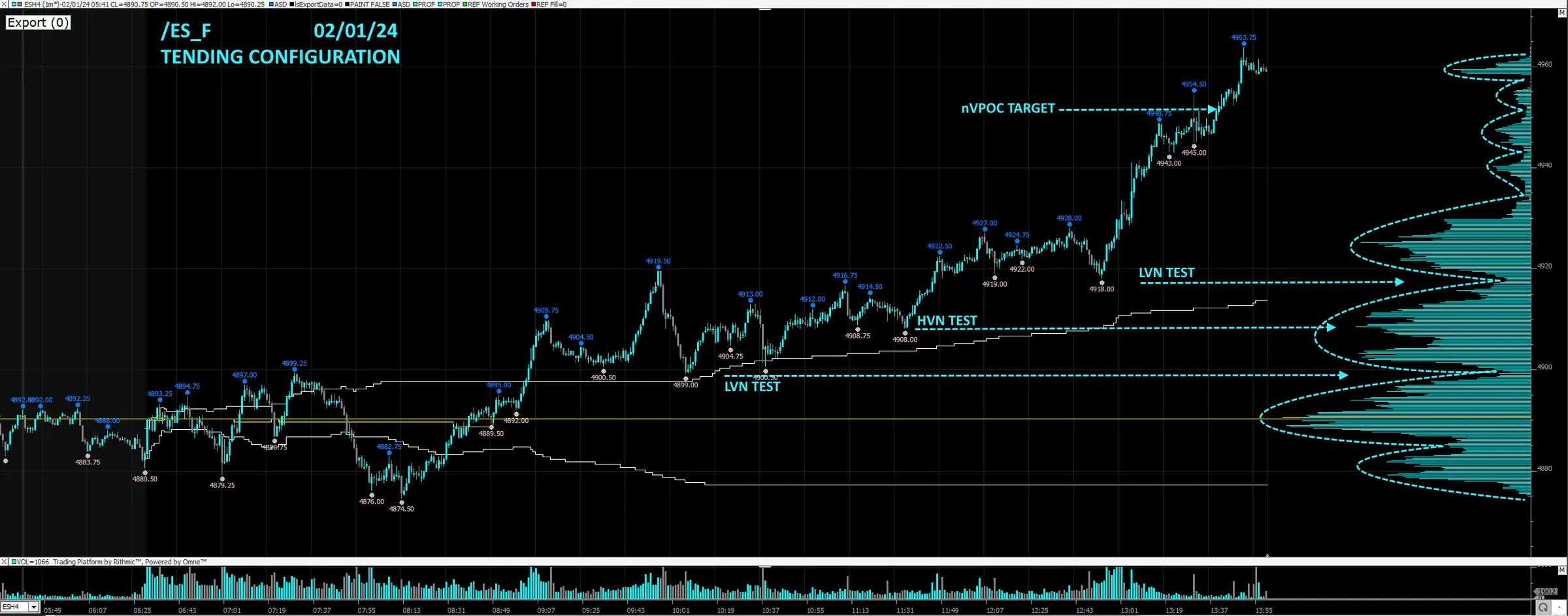
A trending context begins when the auction breaks from balance and establishes an imbalance or price-discovery process. In this condition, the developing profile is less symmetrical. High-volume and low-volume areas create a jagged, “toothy” structure with temporary consolidations along the directional path.
Because the developing session no longer contains a stable center of value, we lean more heavily on higher-time-frame references: composite and micro-composite distributions, previous RTH profiles, naked VPOCs, and material high- and low-volume nodes.
A trending auction can begin with balance before acceptance shifts and price discovery takes control.
This example also shows why context is not black and white. Early in the session, the market behaves as though it is balanced and mean-reverting while gradually expanding its range. When the auction finally pushes through the upper boundary, returns to test the outside edge, and rejects lower prices, the imbalance becomes clearer.
The initial VPOC remains behind. Consolidations along the way do not produce enough acceptance to migrate fair value, yet the directional auction leaves visible HVNs and LVNs in its wake.
Using Higher-Time-Frame References
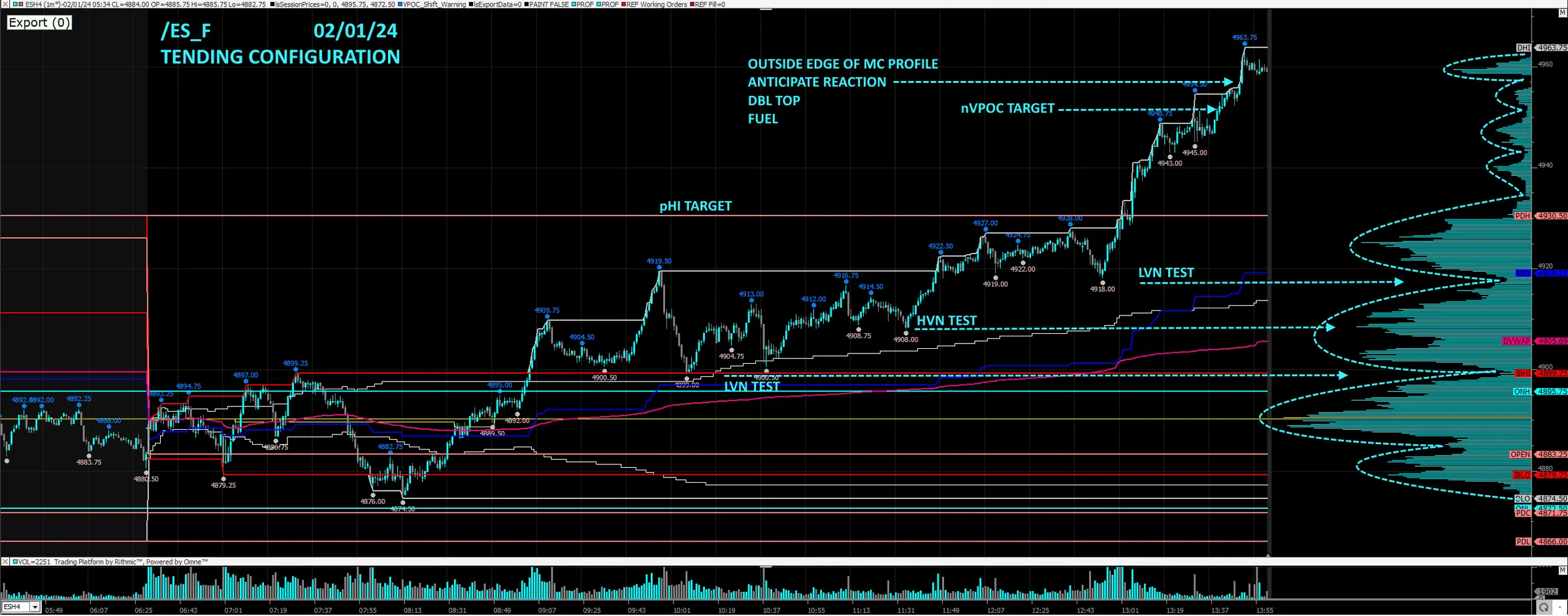
The trending auction with additional session, prior-day, and micro-composite references.
With more context restored, we can see that the initial break occurred through the Initial Balance High (IBH). The auction then continued to make higher highs, moved through the previous high (pHI), and approached a naked VPOC and the outside edge of a broader micro-composite distribution.
That outside edge is a material “big door.” The auction may open it and continue searching for higher price, or close it through rejection and return toward a higher-volume area below. These references are not predictions. They are locations where we anticipate a meaningful price check.
“The market goes up to come down and goes down to come up.” — Tom B.
Scenario Analysis
Scenario Analysis asks a disciplined question: If this, then that. If not, then what?
Using Auction Market Theory and Volume Profile, we organize hypothetical outcomes around material information—HVNs, LVNs, VPOCs, distribution edges, prior-session references, and the conditions required by our own trading setups.
A useful scenario examines practical constraints:
• Does the location provide enough range to initiate the trade? • Is a nearby stop-rich area likely to disrupt the entry? • Does another material reference sit in front of the target? • Given the opening location, should we anticipate responsive buying, responsive selling, or continued initiative activity?
The purpose is not to predict every move. It is to prepare responses before pressure arrives.
A micro-composite view used to map two-sided scenarios before the RTH session develops.
Building a Two-Sided Plan
In the example above, the market opens in range but outside the prior session’s value, near a micro-composite high-volume node (mcHVN). One scenario anticipates continuation of the selling seen during the overnight session, targeting lower-volume areas and the lower edge of the distribution.
But what if sellers cannot continue producing lower prices? If the auction turns upward, we ask whether the reversal occurred at a material reference, whether upside targets remain available, and which mcLVNs, mcHVNs, mcVPOCs, or naked VPOCs must be navigated along the way.
Both scenarios are prepared before execution. Neither requires emotional allegiance. We do not need to be right about direction; we need to recognize what the auction is actually doing and apply the appropriate plan.
Anticipate to participate. Prepare both paths, then let the auction choose.
Questions for the Opening
What does your preparation look like before the RTH open? Which references are material? What behavior would confirm the primary scenario—and what behavior would invalidate it?
Continue narrating as the session develops. Context can change at any time. Balance can become imbalance. A trend can stop, build acceptance, or reject a material level and rotate aggressively toward the opposite side.
When the auction provides new information, update the scenario. When it does not, wait.